OVN Incremental Processing Engine
The OVN Incremental Processing Engine is a framework designed to efficiently handle changes in input data (e.g., Southbound DB tables, local OVSDB interfaces) and update the desired state (e.g., OpenFlow rules) accordingly. Instead of performing a full recomputation whenever an input changes, which can be inefficient for large datasets, the engine tracks changes and processes them incrementally.
Concepts
The engine is composed of a Directed Acyclic Graph (DAG) of engine nodes.
Engine Node: Represents a unit of data processing. Each node maintains its own data, which persists across main loop iterations.
Inputs: Nodes can have inputs (dependencies) from other nodes.
Change Handlers: For each input, a user-defined change handler function can be implemented. This function processes the changes from the input and updates the node’s data.
Run Function: If no change handler is defined for an input, or if the change handler returns EN_UNHANDLED, the node’s run method is called to perform a full recomputation based on all inputs.
The engine facilitates:
Correctness: By making dependencies explicit.
Maintainability: By providing a structured way to implement complex logic.
Scalability: By enabling fine-grained, incremental updates.
Engine Node State
The whole graph is processed by a single top-level engine_run(bool recompute_allowed) call, typically made once per main loop iteration; this is distinct from the per-node run method described above. The state of an engine node (enum engine_node_state) describes the validity of its data after such an engine_run() call:
EN_STALE: The data in the node is not up to date with the DB or its inputs. This is the initial state before the engine runs.
EN_UPDATED: The node’s data is valid and was updated during the last engine run. This indicates that downstream nodes may need to process these changes.
EN_UNCHANGED: The node’s data is valid and did not change during the last engine run. Downstream nodes can skip processing if they only depend on changed inputs.
EN_CANCELED: Processing for this node was canceled during the last run. This usually triggers a full recomputation in the next iteration.
Engine Invocation per Binary
The recompute_allowed argument to that call is what determines whether cancellation can happen: a node is canceled when it is marked as writing to the Southbound DB (sb_write) and needs a full recompute while the caller passed recompute_allowed = false. Cancellation stops that engine run immediately; the whole graph is retried once recompute_allowed is true again on some later iteration, which need not be the very next one.
ovn-northd calls engine_run() only once it holds the Southbound DB lock and has valid Northbound and Southbound transactions in hand. ovn-ic similarly checks that all four of its NB/SB/IC-NB/IC-SB transactions are non-NULL. Otherwise, they skip running the engine for that iteration entirely. Because of this, they always pass recompute_allowed = true and their nodes are never canceled.
ovn-br-controller’s nodes are never canceled either: it connects to two databases – the local Open_vSwitch database and the separate OVN Bridge database – but only reads from them. Unlike ovn-northd and ovn-ic though, this isn’t an enforced guarantee: its precondition for calling engine_run() doesn’t actually check for a valid transaction, it simply happens that no node needs one today.
ovn-controller takes a different approach: it calls engine_run() on every main loop iteration regardless of whether a full recompute is currently possible, so that purely incremental changes can still be processed even when a full recompute isn’t. It passes recompute_allowed = true only when it has a Southbound DB transaction and no backlog of unsent OpenFlow messages; otherwise it passes recompute_allowed = false, for two reasons:
It has no Southbound DB transaction yet this iteration. If, during that run, a node marked sb_write has an input that changed and needs a full recompute (no change handler for it, or its change handler returned EN_UNHANDLED – see “Run Function” above), the engine cancels that node instead of calling its run method. A recompute would have been unsafe anyway: a write attempted with no transaction can’t be caught by the engine’s write-protection check.
ovs-vswitchd isn’t necessarily unresponsive, but ovn-controller still has OpenFlow messages from a previous round that it hasn’t managed to hand off to the socket connecting to it yet. Rather than wait for any acknowledgment, it simply defers adding more work on top of what’s already queued. This is a deliberate optimization, not a hard requirement.
Input Handler Result
Change handlers return a result (enum engine_input_handler_result) indicating the outcome of processing an input change:
EN_UNHANDLED: The change handler could not handle the input change. This forces the engine to fall back to a full recomputation of the node using its run method.
EN_HANDLED_UPDATED: The change was successfully handled, and the node’s data was updated as a result.
EN_HANDLED_UNCHANGED: The change was successfully handled, but the node’s data remained unchanged.
Usage of these return values allows the engine to optimize the flow of updates through the graph.
Graph Visualization
Understanding the dependencies between engine nodes is crucial for debugging and optimization. OVN provides a mechanism to dump the engine graph in Graphviz DOT format.
Dumping the Graph
ovn-northd, ovn-controller and ovn-ic all support the –dump-inc-proc-graph command-line option.
Note
ovn-br-controller also builds its desired state (bridge flows) using the incremental processing engine, but it does not currently implement –dump-inc-proc-graph.
Full Graph Dump
To dump the entire engine graph, simply pass the option without arguments:
ovn-northd --dump-inc-proc-graph
# or
ovn-controller --dump-inc-proc-graph
# or
ovn-ic --dump-inc-proc-graph
This will output the full DAG definition to stdout.
Partial Graph Dump
For complex graphs, it can be useful to view only a subset of the nodes. One can provide a specific node name as an argument to dump the graph leading up to that node (including the node itself and its transitive dependencies).
# Dump the graph for 'datapath_sync' node in ovn-northd
ovn-northd --dump-inc-proc-graph=datapath_sync

# Dump the graph for 'runtime_data' node in ovn-controller
ovn-controller --dump-inc-proc-graph=runtime_data

# Dump the graph for 'ic' node in ovn-ic
ovn-ic --dump-inc-proc-graph=ic
This allows for focused analysis of specific parts of the processing pipeline.
Example Output
The output is in DOT format and can be visualized using tools like dot from the Graphviz suite.
digraph "Incremental-Processing-Engine" {
    rankdir=LR;
    NB_nb_global [style=filled, shape=box, fillcolor=white, label="NB_nb_global"];
    global_config [style=filled, shape=box, fillcolor=white, label="global_config"];
    northd [style=filled, shape=box, fillcolor=white, label="northd"];
    NB_nb_global -> global_config [label="global_config_nb_global_handler"];
    global_config -> northd [label="northd_global_config_handler"];
}
Edges are labeled with the name of the change handler function if one is registered for that dependency.
The DOT output can be converted to an image (e.g., PNG) using the dot utility from Graphviz:
ovn-northd --dump-inc-proc-graph | dot -Tpng -o engine_graph.png
ovn-controller --dump-inc-proc-graph | dot -Tpng -o engine_graph.png
ovn-ic --dump-inc-proc-graph | dot -Tpng -o engine_graph.png
As an example, here is each binary’s graph rendered up to one representative node:
Note
The images below are a snapshot taken when this documentation was written, meant to illustrate what the generated output looks like. The incremental-processing engine gains and loses nodes and handlers over time, so a graph generated from a current build may no longer match what is shown here exactly. Run the commands above against your own build to get an up-to-date graph.
ovn-northd, up to the datapath_sync node:
ovn-northd --dump-inc-proc-graph=datapath_sync | dot -Tpng -o datapath-sync-graph.png

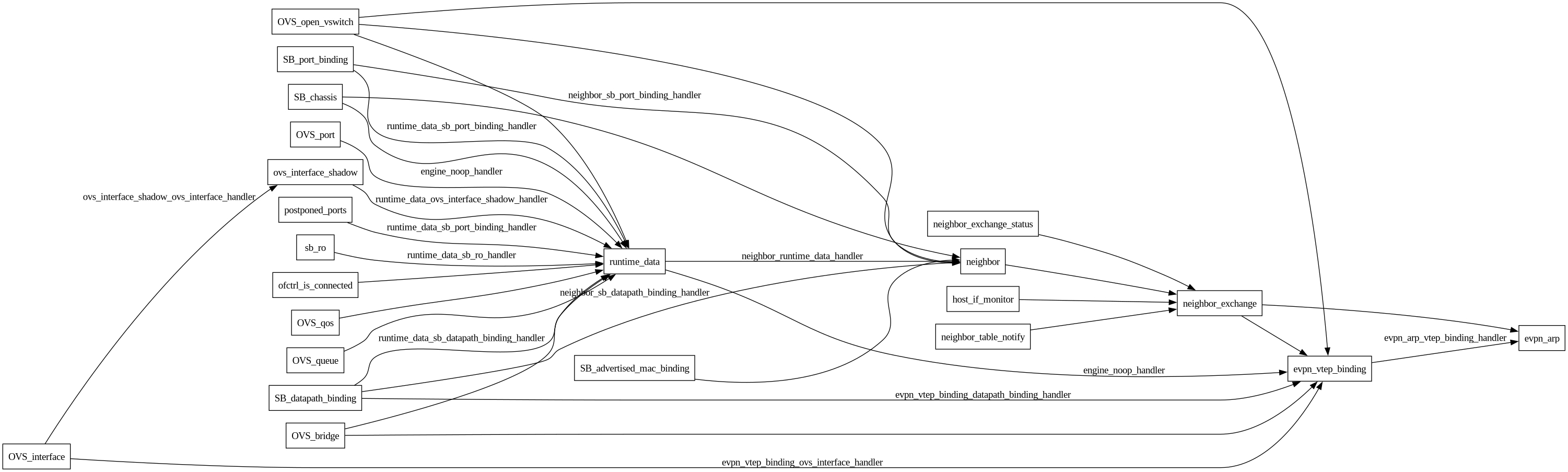
ovn-controller, up to the evpn_arp node:
ovn-controller --dump-inc-proc-graph=evpn_arp | dot -Tpng -o evpn-arp-graph.png
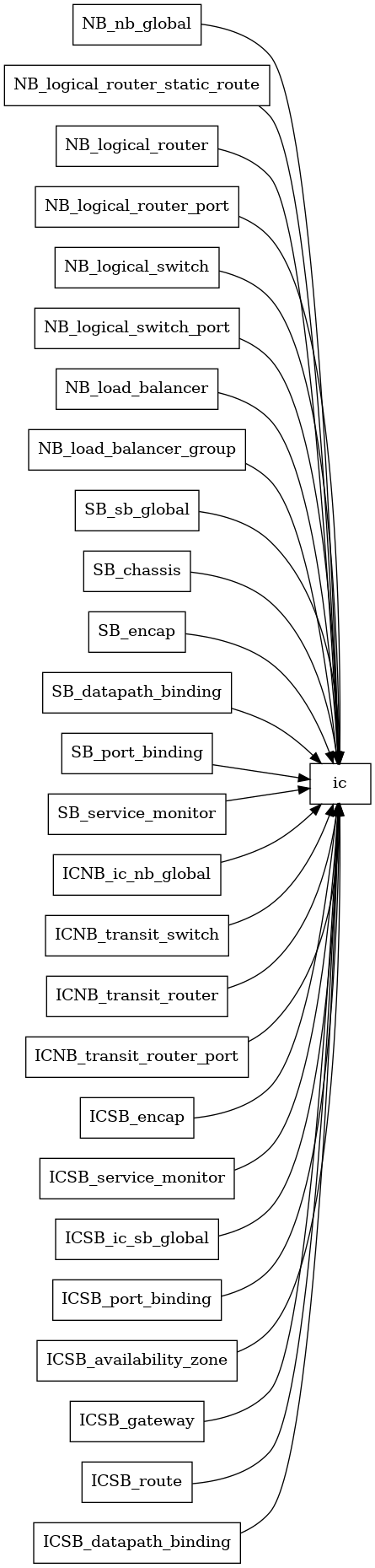
ovn-ic, up to the ic node:
ovn-ic --dump-inc-proc-graph=ic | dot -Tpng -o ic-graph.png
Runtime Introspection
ovn-northd, ovn-controller, ovn-ic and ovn-br-controller all register the same set of ovn-appctl/ovs-appctl commands for inspecting and controlling the engine at runtime:
inc-engine/show-stats [node] [counter]: Display the per-node recompute, compute and cancel counters. If node is given, only that node’s counters are shown; counter further restricts the output to one of recompute, compute or cancel.
inc-engine/clear-stats: Reset all engine counters to zero.
inc-engine/recompute: Force a full recompute of the engine on the next iteration, bypassing incremental change handlers.
inc-engine/compute-log-timeout <msecs>: Set the threshold, in milliseconds, above which a node’s compute/recompute time is logged as slow (default 500ms).
inc-engine/list-stopwatches [node]: List engine nodes and, for each, the change handlers that can be timed. If node is given, only that node’s handlers are listed.
inc-engine/enable-stopwatch [node]: Start timing recompute and change handler invocations for node, or for every node if omitted. Results are viewed with the stopwatch/show command. Stopwatches are disabled by default, as they add measurable CPU overhead.
inc-engine/disable-stopwatch [node]: Stop timing for node, or for every node if omitted. This is the default state.
Implementation Details
The engine core is implemented in lib/inc-proc-eng.c and lib/inc-proc-eng.h.
Key Structures
struct engine_node: The base structure for a node. Contains inputs, data, state, callback functions (run, init, cleanup, is_valid, clear_tracked_data, get_compute_failure_info), the per-node stats counters exposed by inc-engine/show-stats, and the stopwatch_enabled flag toggled by inc-engine/enable-stopwatch and inc-engine/disable-stopwatch.
struct engine_node_input: Describes a dependency on another node and the associated change handler.
struct engine_context: Carries the OVSDB transaction handles for the current iteration, plus an opaque client_ctx pointer that each binary uses to pass its own private state (e.g. ovn-controller’s controller_engine_ctx) through to run() methods and change handlers. Accessed with engine_get_context().
Usage Guidelines
When working with the incremental processing engine:
Focus on Data: Design nodes based on the data they maintain.
Explicit Dependencies: Avoid using global variables. All inputs should be explicitly defined in the graph.
Handle All Changes: Ensure that for every input, either a change handler updates the node correctly, or the run method recomputes it entirely. Returning EN_UNHANDLED from a handler triggers recomputation.